
I design interactive mathematical learning experiences that help learners discover structure through play, experimentation, visual reasoning, and guided feedback.
These selected samples combine my background as a mathematics lecturer, game theory specialist, educational technology lead, and public-facing educational content creator.
Featured learning design samples
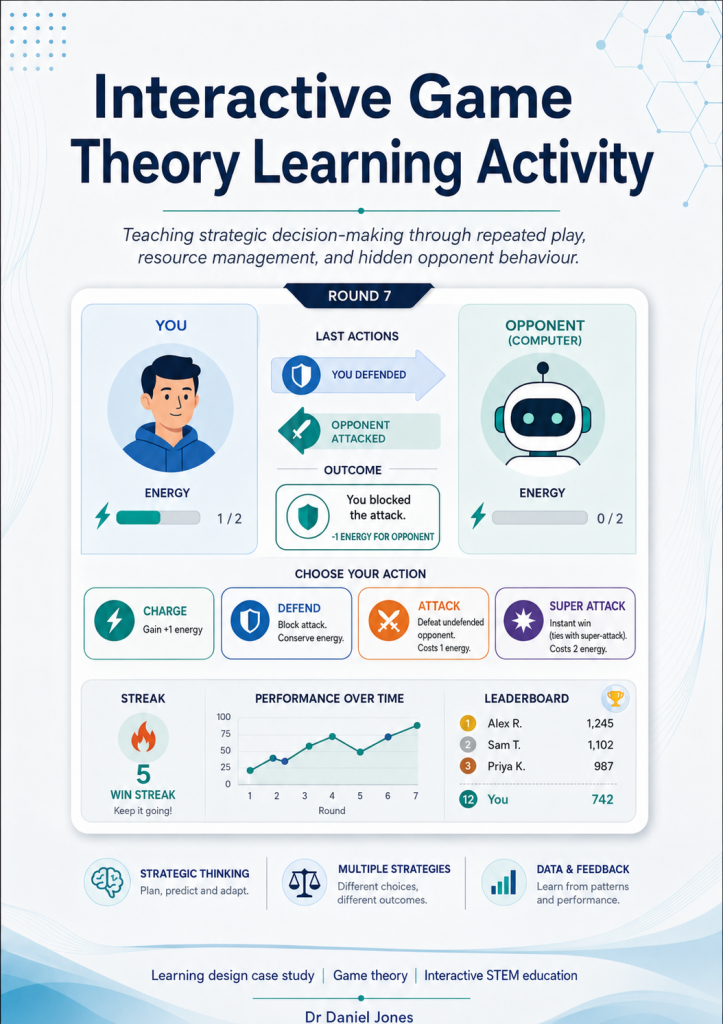
Interactive Game Theory Learning Activity
A case study of an energy-based repeated game I designed and built for Year 3 Game Theory students at the Jinan-Birmingham Joint Institute. Learners manage resources, receive immediate feedback, and infer hidden opponent behaviour while discovering strategic cycles, best responses, and game-theoretic reasoning through play.
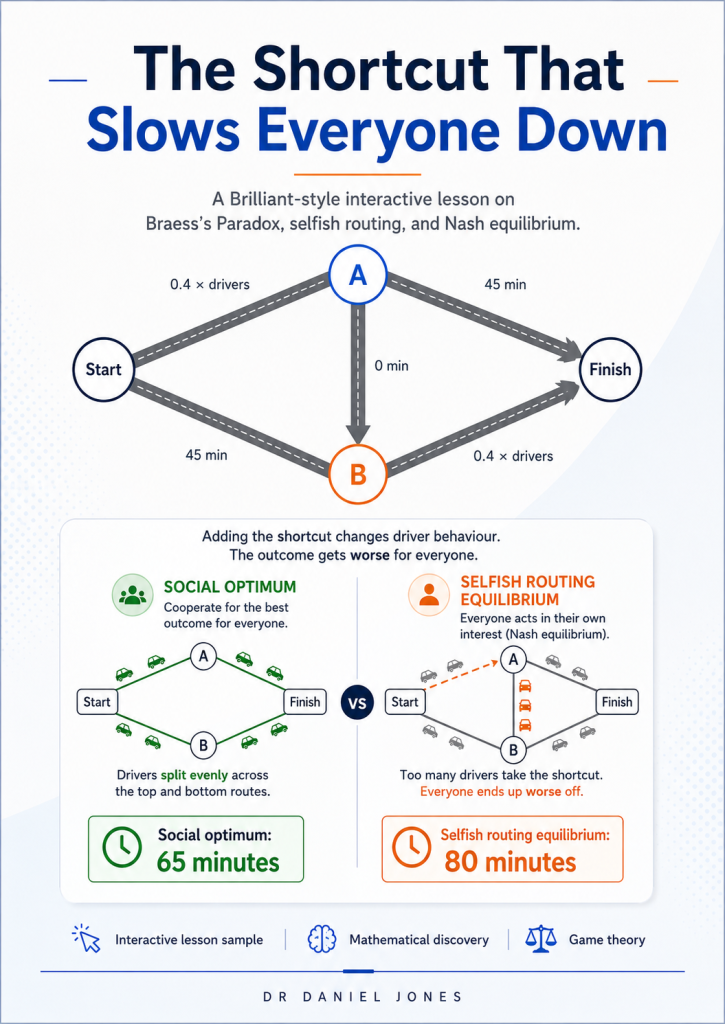
The Shortcut That Slows Everyone Down
A Brilliant-style interactive lesson sample on Braess’s Paradox. Learners explore a traffic network, predict the effect of adding a shortcut, then discover how individually rational choices can make everyone worse off. The lesson introduces Nash equilibrium, social optimum, and the hidden cost of selfish routing through guided experimentation.
Supplementary teaching samples
How to Solve a Rubik’s Cube — a public-facing instructional article showing how I break a complex puzzle into a clear, visual, beginner-friendly learning sequence.
Chess Red Flags #3: Slow Moves That Lose Fast — a supplementary online teaching sample showing how I explain strategic reasoning through visual examples and memorable decision-making frameworks.
Design philosophy
Across these samples, my aim is to begin with learner action, create curiosity or surprise, and then use mathematics to explain the structure the learner has discovered. I am especially interested in interactive lessons where students test ideas, receive feedback, and build intuition before formal concepts are named.